Rapa Nui, Chile #8
November 2,
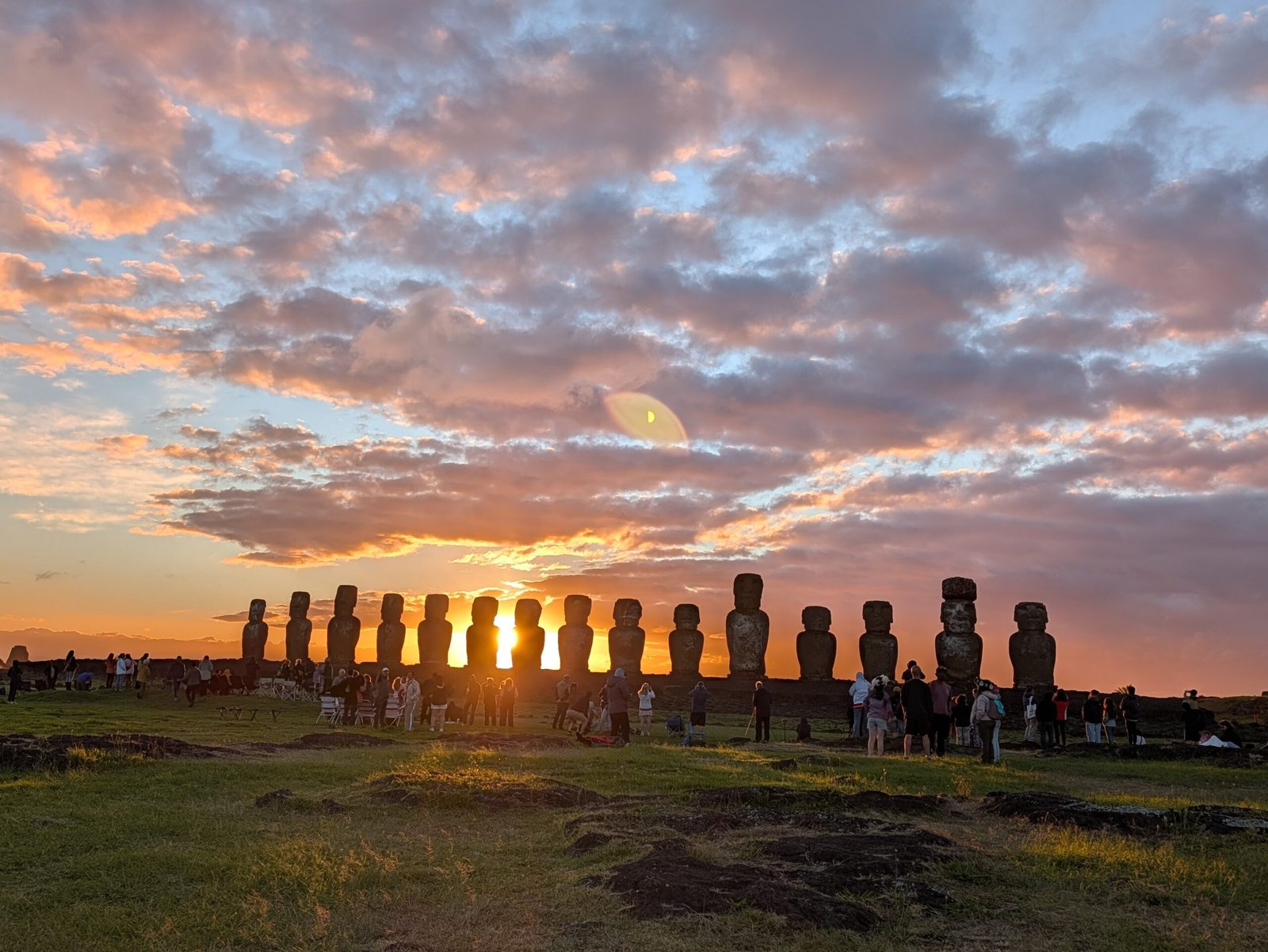
Up at 0515, by the alarm and ready to go by 0540. As we waited for our ride, we saw the night sky…the moon and the stars…excellent! Also we got to pet a dog as we waited. Pet therapy helps anxiety.😟 I say this because the bus didn’t show up until 0614! …Island time, I tell myself. We loaded into a mostly full minivan, picking up four more people – now we were full! We were driven, listening to music – and an Asian couple on their phone. We had arrived at our sunrise spot by 0650. We unloaded, were given a chair – but no instructions.
So we meandered following the people to where we were checked in by a National Park person. We showed our e-tickets, and were finally led down into a slightly depressed area of earth. There were 15 Moais lined up next to each other. The Moais backsides were faced toward the sun as if to be expectantly warmed. We had a brief wait then the sunrise evolved, better than we’d expected. We stayed and were able to walk about. I took lots of photos as did others. Finally the “tour guides” herded up our group. We went back to the minivan for a breakfast of champions: cafe/tea and cookies.
On the drive back we could now see the volcanic terrain, a couple of mountains, maybe volcanoes. We also saw free range horses and cattle. Our minivan pulled back into the office by 0830. We went to a mini mart and grabbed a chicken salad sandwich, more “cafe,” and ate our bananas. We went back to the office. Carla charged my phone (I hadn’t done it enough last night and remember I took a lot of pictures already).
At 0925 the next part of our tour started. Our guide introduced himself as Hugo with Hosea as driver. Yeah a real guide. He then asked if we had any questions. One lady said, “Yes, but it was too many…just talk of the Island.” That he did. He covered so much, but some stuff he stated 70 to 80,000 people were believed to have lived at its highest population, but Hugo doesn’t believe that many lived here at one time. There are more horses than people now. The population is 7,500 to 8,000 – with 4,000 being native Rapa Nui descent. Another fact, Americans built the airstrip here. It is super long and was an emergency landing spot for the space shuttles.
We arrived at our first site, Vinapu. Hugo started by answering a question…”why are guides needed?” He explained of tourists who climbed on the Moais and also defaced one by taking its ear, plus other reasons. We moved to a rock, not a head. He spoke of mummification and cremation. The ancient peoples did both, with mummification being the primary, but changed to the latter. He explained this over a hewn-out rock out – like a trough, where some mummy processing would have occurred. (He goes into much more detail. I’m only giving highlights that I remember and struck me.) At this site, there were knocked over Moai stones and a buried face of a Moai stone. He explained the Moais originally had eyes – which gave them “life” – that were made of coral and red scoria(lava rock) or obsidian. No Moais today have any of these eyes – for various reasons, but mostly due to natives destroying the life of an ancestor (which the Moais were built to represent) during local warring factions. These wars led to some of the stones being pushed over to break, symbolic of killing the ancestor. We loaded up/moved to the next site.
The second site was Rano Kau, a volcano crater where Hugo said his great grandma trekked down to the water to do her family’s laundry, as all her ancestors did. But his grandmother and all the new generations don’t mimic that. It was quite a crater, with very steep sides…I could not imagine being laundry down that! The water in the crater had the same kind of grass as what is on Lake Titicaca. Huh! There are 52 volcanoes that make up the island, but only three main ones. This was one of the three. The last one ceased being active one million yrs ago. We overlooked the only town on the island, Hanga Roa, where we are staying.
The third site, Oronjo, was on the other side of the volcano. Here the Tangata-Manu (Birdman) competition took place. One warrior of each of seven tribes was chosen to represent them. The race commenced from a massive rock with a climb down 200 m vertical cliffs, and swim 1800 m to three little islets just off shore. There they collected the first migratory seabird eggs of the season, and returned to Rapa Nui climbing the vertical seaside of the volcano to the starting rock and finish first (hopefully) to claim ritual power and honor for their king and clan for the year. Also there were oval shaped places (restored) for the people to sleep. Hugo told us the race time was decided by aligned statues (one was Hoa Hakananai’a, which is in the British Museum) that lined up in formation only one time of the year forming the southern cross. This determined the time to collect eggs – springtime.
At the fourth site was a solitary statue, Ahu Huri a Urenga, which Hugo called “Looking Up to the Stars.” The statue was set on a long platform base and astronomical lines up for winter (June 21). It has four hands and by oral legend, they represent four months of a calendar. It has been broken and repaired with cement. We were rained on a bit here.
The fifth site was Puna Pau. It was a smaller quarry that made the crowns or hair for many of the Moais, which many don’t have anymore. The rock from here had a distinctive red coloration.
The last and sixth site was Ahu a Kivi. Hugo’s uncle was here at the entry, smiling. His uncle helped in the restoration process in the 1960’s!! There were 7 Moais lined on a platform and they were instrumental in the spring equinox. Hugo told of a long oral tradition of how the island came to be settled. These Moai are the only ones set that face the sea, all the rest have their backs to the sea facing the villages that would have been there.
The tour ended and we were driven back to the office. We thanked Hugo, as he was an excellent guide. We tipped him with 10,000 CLP, just over $10. The three Polish ladies asked to be let out at Ma’a Hore, a local traditional food place for lunch and we got out with them.
We both had fried Pua (the catch of the day). They had fish soup and thought they had ordered some fried fish as well. But they never got anything. So one of them questioned and finally they were served some sort of cooked eel. They said it was full of bones and not much meat. I would not have liked it. Our order was a small white fried fish that came with rice, sweet potatoes, salad and a banana fried bread (kind of like a donut hole). Also we both had a mango juice. We ate and talked with them for quite some time. Our bill was 61,000 CLP ($62.13). Then we walked back to our place and had a siesta! Then we showered and I started this blog (but didn’t finish it). I had a few peanuts, but Jeff did not want any. We then had some chocolate and chocolate whiskey, to toast our fantastic, glorious first day on Rapa Nui. We did go out and watch the sunset over the sea (sunset is late – 2037). Bed by 2200.